
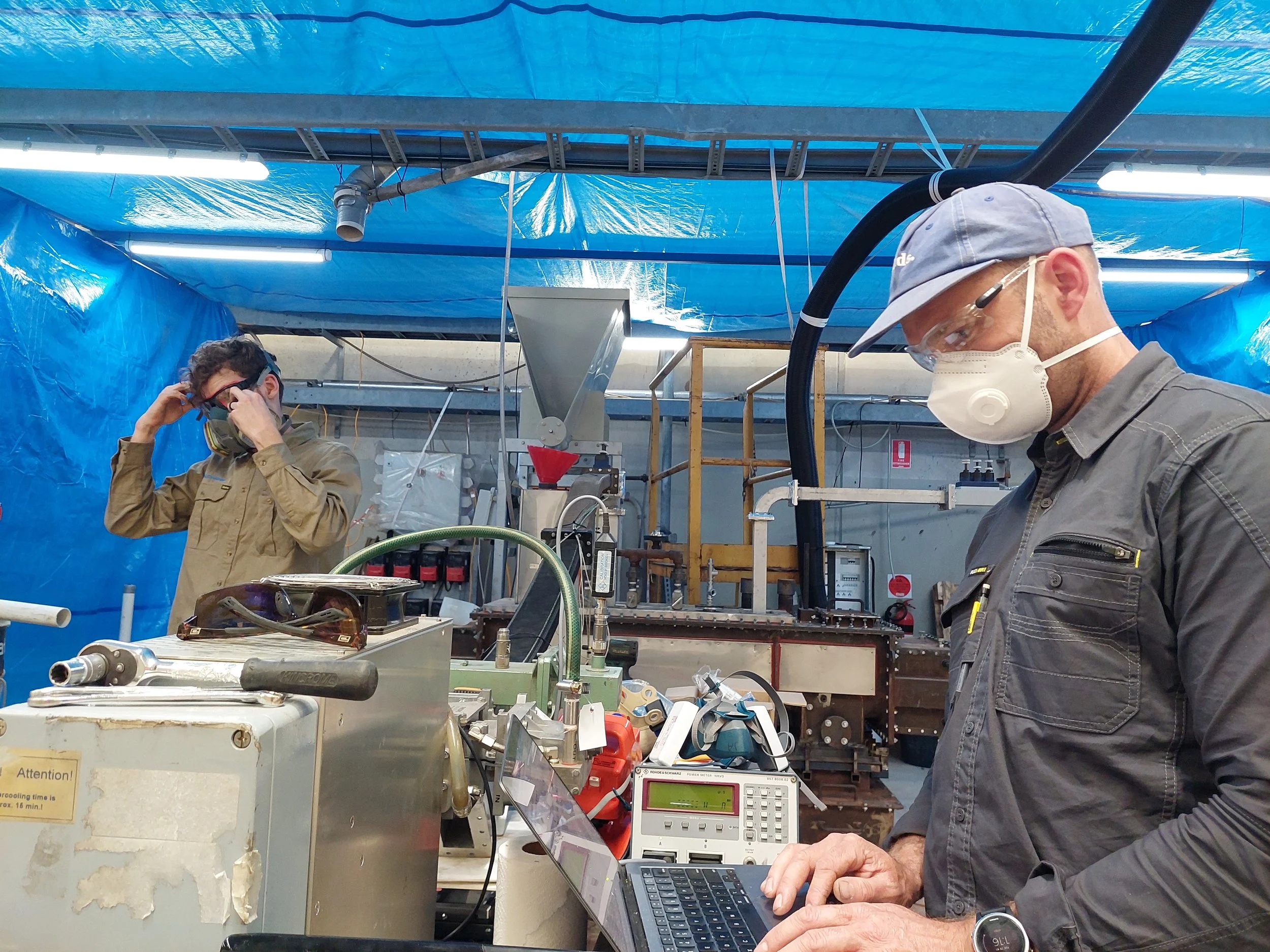
Is Microwave Right For Your Process?
Before committing to equipment or a larger development program, AMT can help determine whether microwave processing offers a genuine technical or commercial advantage for your application.
Preliminary studies and targeted laboratory tests can reveal promising opportunities, identify the most useful development path, or show where further investment is unlikely to pay off.
START WITH THE PROCESS, NOT THE MICROWAVE
A material heating successfully in a microwave does not necessarily mean microwave processing will be practical or economical at industrial scale.
The important question is what microwave energy could make possible in the process - whether it can solve a real problem, create a useful advantage or enable something difficult to achieve with conventional heating.
AMT can assess the material, process conditions, throughput, existing heating method and project objectives to identify what is worth investigating and the most useful way to test it.

WHEN IS MICROWAVE WORTH INVESTIGATING?
Microwave is worth investigating when…
Heat transfer is limiting the process and volumetric heating could provide an advantage.
Selective heating of one material or component is useful.
Rapid heating or response matters.
Conventional heating struggles with the material, product size or geometry.
The process would benefit from direct electrical heating rather than combustion.
High temperatures or high energy density are required.
A chemical reaction or transformation could benefit from rapid or selective heating.
Existing heating creates a particular quality, throughput or control problem.
Microwave may not be the best option when…
The material couples poorly with microwave energy.
Conventional heating already works efficiently and economically.
The process geometry makes useful field control difficult.
Required throughput would make the microwave system disproportionately expensive.
The expected technical benefit is too small to justify development and scale-up.
A simpler heating technology can achieve the same result.
Not sure which category your process falls into?
Often that is exactly what an early-stage investigation is intended to establish.
EXPLORE THE POTENTIAL BEFORE YOU SCALE
Preliminiary work can answer the important questions early, while the project is still inexpensive and flexible.
Testing may confirm a promising idea, uncover an unexpected process advantage, suggest a better direction - or show that microwave is unlikely to justify further development.
1. Explore the idea
Review the material, process, current heating method, throughput, temperature requirements and what you are trying to achieve. Identify where microwave could potentially offer an advantage.
2. TEST WHAT MATTERS
Where necessary, AMT can carry out focused laboratory tests & simulation to investigate microwave coupling, heating behaviour and the key technical uncertainties.
WHAT MIGHT WE DISCOVER?
PROMISING — DEVELOP IT
Testing shows a useful technical or commercial advantage worth developing further.
INTERESTING — REFINE IT
There is potential, but the process or original concept needs adjustment.
3. UNDERSTAND THE RESULT
Use the evidence to determine whether the idea is promising enough to develop, needs refinement, or is unlikely to justify further work.
NOT ENOUGH — STOP EARLY
The evidence does not justify substantially more development expenditure.
The scope can be kept proportionate to the question being answered, from an initial technical review through to targeted laboratory testing.

WHAT CAN WE FIND OUT EARLY?
An initial assessment does not need to answer every question about a future commercial system.
The aim is to identify the questions that matter most and answer those first - quickly building evidence around the idea without trying to design the entire commercial system at once.
PROCESS ASSESSMENT
Review the material, current process, heating method, required temperatures, throughput and the improvement being sought.
TEST CONFIGURATION
Use software simulation alongside practical testing, where appropriate, to investigate applicator geometry, microwave behaviour and promising configurations before committing to more extensive hardware development.
MICROWAVE RESPONSE
Test how the material responds to microwave energy, including heating behaviour, power absorption and any obvious processing limitations.
SCALE-UP SCREENING
Consider what the simulation & laboratory results may mean for higher power, continuous processing, equipment requirements and the potential and practical requirements for further development.
HAVE AN IDEA WORTH TESTING?
You don't need a finished system design or detailed microwave knowledge to start an investigation.
If you can explain the material or process, what you're trying to achieve and what isn't working well today, AMT can help identify the first useful questions and the simplest practical way to investigate them.
If the results are promising, the work can progress into further laboratory trials, process development and scale-up.