
INDUSTRIAL MICROWAVE FEASIBILITY TESTING
AMT designs and carries out focused feasibility studies and laboratory trials to investigate how materials and processes respond to microwave energy, identify useful operating conditions and generate evidence for the next development decision.
FOCUSED TESTING, BUILT AROUND THE PROCESS
A useful microwave trial starts with the technical question, not with a standard test procedure.
AMT considers the material, existing process, desired outcome, previous work and practical constraints to determine what should be investigated and how to test it meaningfully.
The work can be tightly scoped around a single question or form the first stage of a larger development program.
WHAT CAN A LAB TRIAL REVEAL?
A focused trial can answer very different questions depending on the material and process. Typical areas include:
MATERIAL RESPONSE:
Microwave absorption and coupling
Heating rate and temperature behaviour
Heating uniformity and penetration
Selective heating between different materials or phases
PROCESS EFFECTS:
Changes in reaction rate or process behaviour
Physical or chemical transformations
Effects on product or material characteristics
Promising temperatures, times and operating conditions
ENERGY & THROUGHPUT:
Energy required to achieve the target temperature or process change
Estimated microwave power required for the desired throughput
Heating time and residence-time requirements
CONFIGURATION & DEVELOPMENT:
Appropriate microwave power and frequency
Applicator and field behaviour
Impedance matching and operating configuration
Factors likely to matter when moving toward larger-scale processing
HOW AMT APPROACHES FEASIBILITY WORK
Not every project needs the same investigation. AMT starts with the process requirements, identifies the important unknowns and uses calculations, simulation and practical testing where they will provide useful evidence.
01 - PROCESS & ENERGY DUTY
Establish the material, starting and target conditions, throughput and required process change.
First-pass mass and energy calculations can then estimate the heating duty, residence time and microwave power range likely to be required.
02 - DESIGN THE INVESTIGATION
Identify what cannot be answered from calculations alone and determine the most useful way to investigate it.
This may involve desktop engineering, simulation, laboratory testing (or a combination) with the test configuration built around the process.
03 - TEST & MEASURE
Carry out controlled trials to determine how the material or process actually responds.
Depending on the application, this may include heating rate, absorbed energy, temperature behaviour, uniformity, selective heating, reaction effects, material changes and operating stability.
04 - INTERPRET & DEVELOP
Compare the measured behaviour with the original energy, throughput and process requirements.
Use the evidence to identify promising operating conditions, remaining uncertainties and the most useful next step — further testing, process development, higher-power work or scale-up.

PRACTICAL DEVELOPMENT CAPABILITY
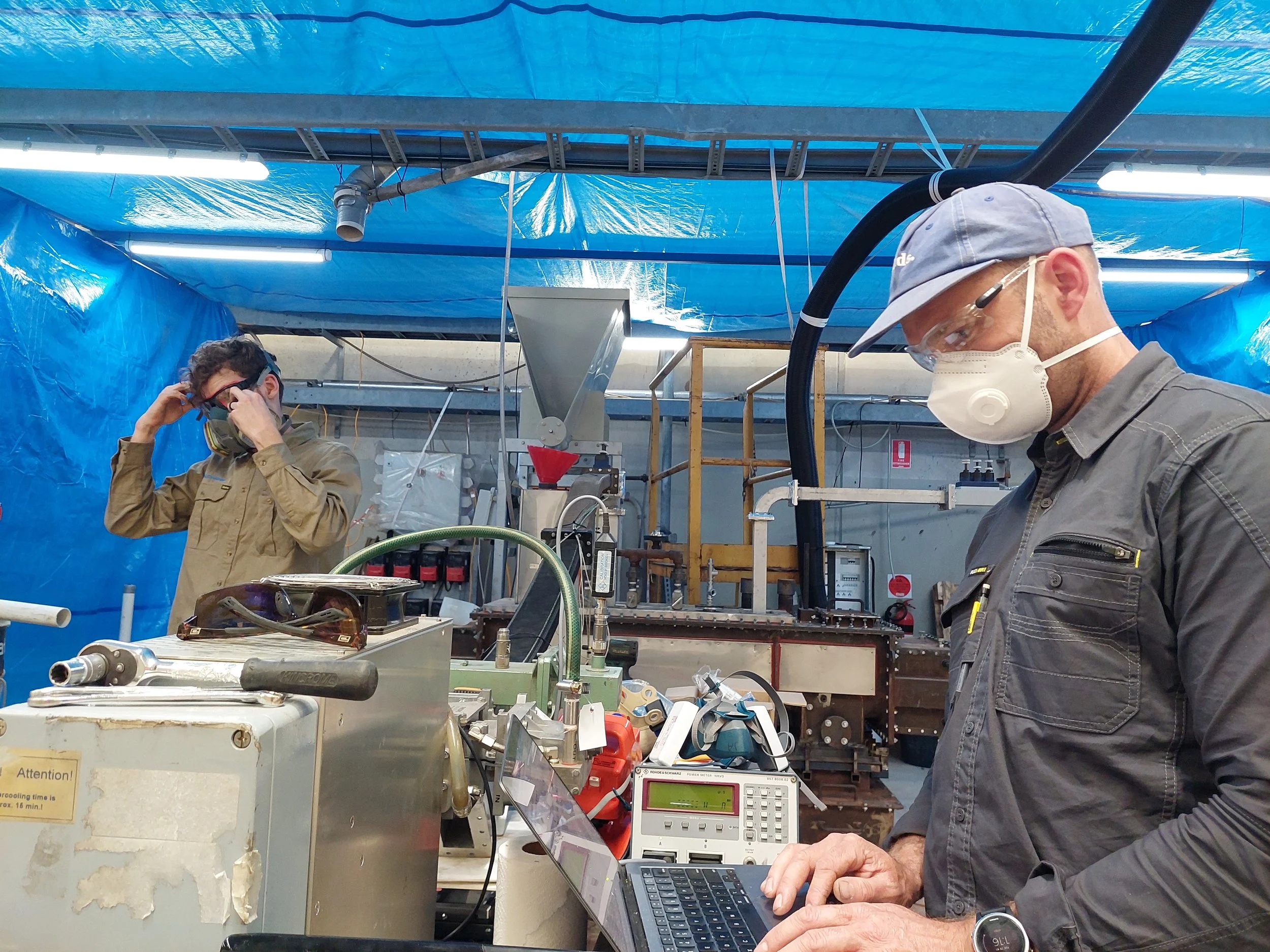
AMT maintains an industrial microwave development facility in Wollongong with the equipment and flexibility needed to investigate processes at a meaningful engineering level.
Microwave generators, impedance-matching equipment, network analysis, simulation capability, instrumentation, existing applicators, specialised process hardware and in-house fabrication can be brought together as required for each investigation.
Many focused laboratory trials can be completed within a few days. A typical program may involve around one day of setup and two days of testing, followed by results analysis or external laboratory analysis of the processed material.
· Industrial Microwave Power · Impedance Matching · EM Simulation · Measurement · Applicators · Process Hardware · Fabrication

FROM TRIAL TO DEVELOPMENT
A feasibility trial does not need to produce a finished process. Its purpose is to generate enough useful evidence to decide what should happen next.
Where results are promising, AMT can continue into process and applicator development, higher-power testing, pilot-scale work and industrial scale-up.
Where results are less clear, the next step may be further targeted testing, a revised configuration or a different process approach.
HAVE A MATERIAL OR PROCESS YOU WANT TO TEST?
Tell us what you’re working with, what you’re trying to achieve and what you already know. AMT can help identify the most useful questions to investigate and an appropriate way to test them.